
WINDOW TREATMENTS AND THEIR APPLICATION TOWARDS ENERGY EFFICIENCY IN THE BUILT ENVIRONMENT
The first addition of SANS 204 was anticipated for a long time; it used to be a voluntary standard and became written into law applicable as of 11 November 2011. In brief, the objective of the SANS 204 energy efficiency provisions is to reduce operational energy use of new buildings without reducing comfort and amenity.
SANS 204 requirements primarily address two components, firstly Heat flow – in and out of a building through the building envelope and secondly Services – that use energy e.g. air-conditioning and hot water installations.
This article will focus on one issue not addressed in SANS 204; namely the application of window treatments to contribute to energy efficiency in the built environment. The practical examples that will be discussed cannot only be applied effectively to new buildings but also to existing buildings.
There are 3 methods how energy can be transferred through windows; 1) conduction, 2) radiation, 3) convection and 4) air leakages.
Window treatments effectively reduce conduction and convection and, to a smaller extent, radiation and air leakage. Every type of window treatment differs in its properties. The different types of window treatments will be discussed in order to know where it can be applied with the maximum result to contribute towards energy efficiency in buildings. One aspect to take into consideration is the orientation of the opening as every façade has its own challenges with regards to energy gain and loss.
Product: Blind Design – Sliding Panel Blinds and Roller Blinds
There is a wide variety of fabrics that could be used to manufacture these types of blinds such as block-out fabrics that will reduce heat loss and -gain through insulation. Different opacities of this fabric are available which contribute to the management of the correct lighting levels required in the specific interior environment. In an office environment, this can be used to reduce solar glare, but still maintain good quality lighting without the need for extensive artificial lighting.
Product: Custom manufactured Curtains
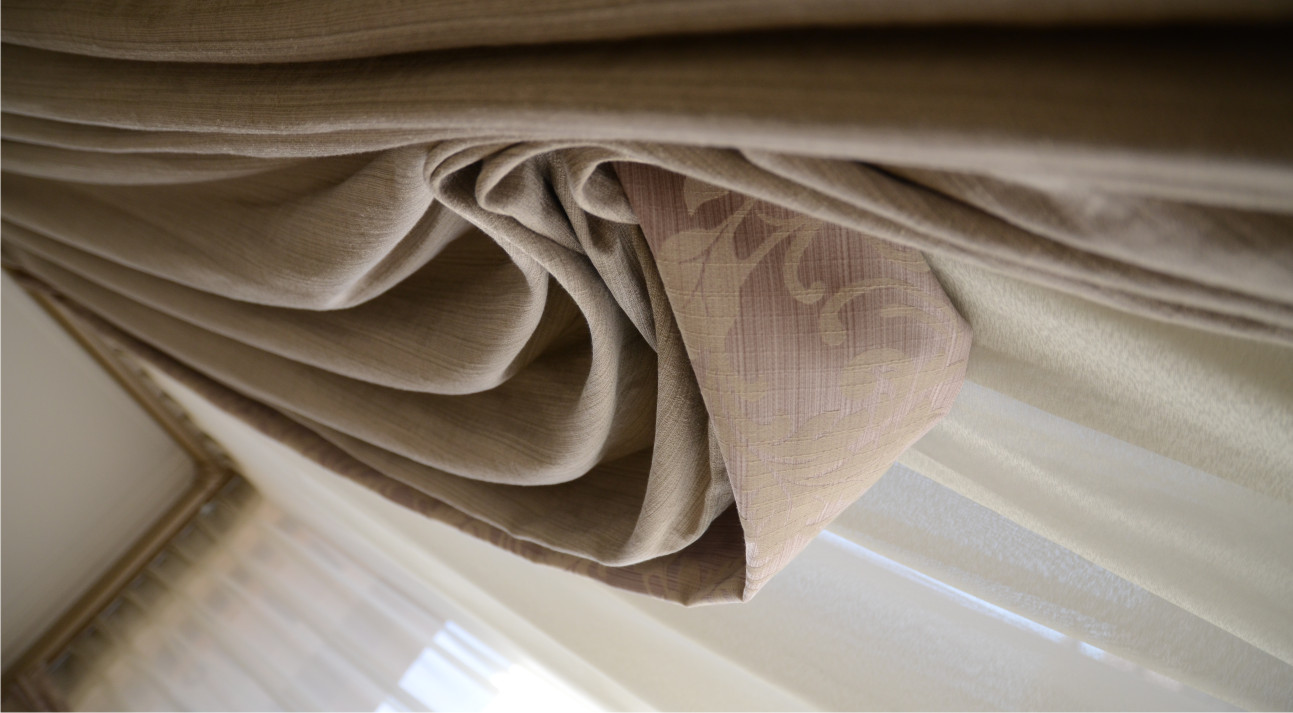
There are an endless variety of fabrics which can be used to maximize insulation of windows, either by reducing heat loss and heat gain. The curtain option can also offer endless combinations which can be used to address diverse or contrasting climate conditions. This can, for instance, be done by layering different types of curtains such as a block-out lining on one rail (which has the insulating property), a middle layer with a decorative treatment and a front layer with a transparent property such as a voile (which will allow for ventilation or air flow).
Product: Blind Design – Horizontal and vertical aluminium blinds
There are various sizes and colours for aluminium blinds available, but the most effective types are reflective. The wider the blind, the more transparent they will be in a horizontal rotation. Reflective blinds can be rotated to reflect more than 90% of radiation. The blinds also create an insulating cavity between the glass plane that will improve insulation to reduce conduction. The second benefit of aluminium blinds is that it can be used to reflect indirect light deep into interiors by adjusting the angle according to the position of the sun and therefore reduce the need for artificial lighting.
Product name: Luxaflex – Duette® shades Type: 64mm Architella®
Duette® blinds have great insulating properties due to its specific structure. These blinds are made with a double layer of fabric combined in a concertina structure that will accommodate pockets of air, thus providing an effective insulating property. The blind insulates by reducing conduction and reducing radiation by using a reflective external fabric.
Product: Blind Design – Motorised Blinds
Basically, any type of window dressing can be motorized which adds to its effectiveness and intelligence of energy control. The motorized system can incorporate internal and external sensor modules which monitor the dynamic weather and solar conditions and will automatically respond to the thermal conditions of the environment. During winter times, insulating window treatments will close to reduce heat loss and reflective treatments will close during summer to eliminate heat gain through radiation.
Apart from the physical contributing factors, window treatments have a central function of adding aesthetics to an interior. Window treatments contribute to softening window openings and in various situations, it has the function of dematerializing the building structure to ‘break the box’. It also brings the exterior into the space and it tends to focus the eye on the view outside instead of the window itself. Another function of window treatments is to add a layer to the building which can be used to control the level of privacy that is required, depending on the specific function of the space inside. Architects often ignore window treatments during the planning process or deliberately ignore the need for window treatments because only the building design is important to them. The fact of the matter is, it is always better to incorporate all elements in a holistic approach in the design which will contribute to the success of the final product.
Leave a Reply